
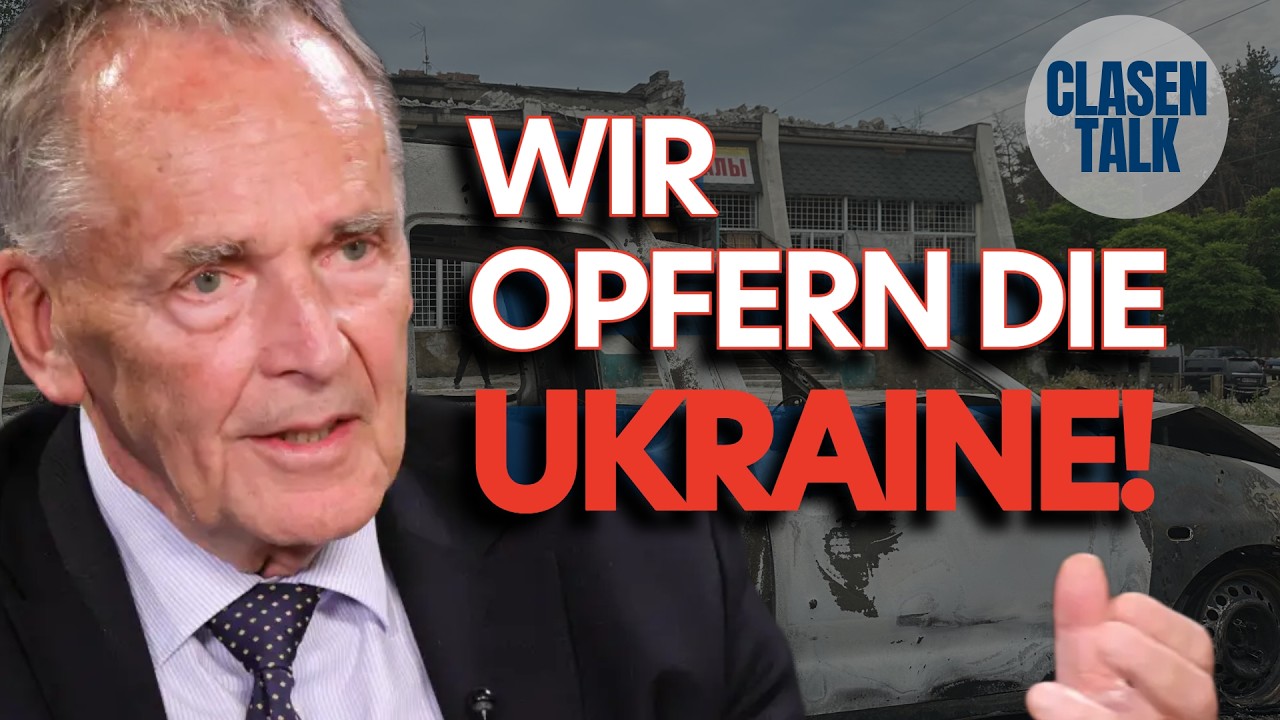
Former top diplomat von Schulenburg slams the EU: “It borders on murder!” – “Negotiate with PUTIN”
Michael von der Schulenburg in an interview with CLASEN-TALK, the podcast from NOZ and SHZ (Neue Osnabrücker Zeitung and Schleswig-Holsteinischer Zeitungsverlag).
The bitter reality of the Ukraine war: Why is the West blocking peace talks? In this in-depth conversation, former top UN diplomat Michael von der Schulenburg (Sahra Wagenknecht Alliance) explains why he considers the current policies of the European Parliament extremely dangerous. Drawing on over 30 years of experience in war zones and crisis areas, he urgently warns against policies that will drive Ukraine further toward collapse.
Key topics in this interview:
Why, according to the former top UN diplomat, the EU Parliament lacks a connection to the realities of war.
The growing danger of nuclear escalation.
Schulenburg’s unofficial peace plan and his talks in Moscow.
[
Auto-transcribed and auto-translated transcript below. Not checked by author.
[music]
Dear viewers, the Urkaine War has now been going on for longer than the First World War. Is there any end in sight to the bloodshed? And why is there no concrete peace plan from the EU? Today, I want to discuss this with a man who has acted as a top diplomat for the United Nations in many war-torn and crisis-hit regions and now represents the Alliance in the European Parliament Wagenknecht from Saarach. A very warm welcome, dear Michael von der Schulenburg.
Michael von der Schulenburg: Thank you very much. Thank you for having me.
Before we turn our attention to Ukraine, I’d like to briefly introduce you, Mr von der Schulenburg, so that the audience knows what a wealth of experience you’ve already gained as a leading diplomat of the Federal Republic of Germany. How many war zones and crisis areas have you been to in your life?
Michael von der Schulenburg: I’ve never actually counted, but I can have a go. Well, I’ve been to Afghanistan several times, to Iran several times, to Iraq, to Syria, Somalia, Sierra Leone – there are a few other places as well, but where I’ve been, well, I’ve actually lived in those countries too, no, I was never just someone who travelled back and forth; I actually lived in these war zones for 30 years and since 1992 I’ve always led the mission, except in Iraq, where I was second in command, but there I was the one in charge because the number 1 had been someone who didn’t have that experience, so I led the negotiations there. Yes.
How often did you yourself fear for your life?
Michael von der Schulenburg: Never.
But were there ever any situations where you actually came under fire?
Michael von der Schulenburg: Well, several times, of course. Yes, of course. Of course. I mean, in Afghanistan, for example. I was in… A cluster bomb exploded above us and I was hit too, though it wasn’t life-threatening, so… we always say it’s enough to make a career of it, but not enough to die or anything like that. So I’ll just head off to the next job somewhere – it doesn’t worry me. I’ve, er, well, in Iraq for example… I ended up at Hannifa Mosque – that’s the centre of the Sunni resistance – where no one else dared to go. So there they were, with 50 US soldiers, in various cars and all sorts of security measures. And and yet there was this roadside bomb – not the sort that goes off there – and it missed my car by half a metre, so between my car and the next one. Then the car bounced up a bit and there was a bit of dust, but then, yeah, then I drove home and the gaming table, and I can’t do that everyone says. The thing is, the UN Parliament makes me much more nervous than all the wars. Somehow, that’s just how I feel. I don’t know why, really.
And why does the European Parliament make you more nervous than a war?
Michael von der Schulenburg: Because there are 719 MEPs there, none of whom have any experience of war, and they are constantly passing resolutions, which, well, actually promote war. And then I think, for goodness’ sake, these people who get up in the morning, have a coffee, take a hot shower, turn up in Parliament and then pass this resolution, but their sons and their daughters aren’t in the war. And, er, having actually seen war and what it means for people, I find the atmosphere there really unpleasant, don’t you? And they’re not interested in talking to me at all. I’m probably the one who knows the most about it, who also knows the most about international law, who, at , especially when it comes to war – I’ve been dealing with that my whole life – the UN Charter, that sort of thing… er, well, of course, they know… they all know better, and there isn’t really any proper discussion in Parliament, is there?
There’s no real dialogue where you can actually get to the. So, I actually found it easier to talk to the Iranians in Iran during the Iran-Iraq War than to the Europeans in the European Parliament. I’m saying this without any ill will. It’s simply astonishing to me, you see, and of course there’s UN Charter. All countries have ratified the UN Charter, so it’s enshrined in their laws, and we’ve all committed ourselves to the UN Charter – all 193 countries and we as individuals too, because it all starts with the people, doesn’t it? We, as human beings, must resolve our conflicts through negotiation. So, if you have this resolution, it runs to 18 pages. There, it says, ‘So, the Taurus should finally be cleared, and we should finally do this and that.’ Er, the worst thing that was ever decided was that, should Ukraine win, Russia would have to be destroyed as a country or partitioned, much like Yugoslavia. That’s the sort of resolution we pass there. And then I think, well, what you’re passing there is basically a provocation towards nuclear war. I mean, have you ever given that any thought? And these resolutions never contain, not even at the very end, a sentence like, ‘Yes,’ ‘perhaps we should negotiate as well’.
You know, during the Cold War, there was the Hammel Doctrine, the Hamel Doctrine. Hammel is the name of a Foreign Minister from Belgium, where NATO decided during the Cold War that deterrence and détente go hand in hand. In other words, on the one hand, we must arm ourselves sufficiently to prevent an attack. On the other hand, we must hold talks with the Russians to see whether this cannot also be achieved through diplomacy. That’s how it was throughout the entire Cold War; otherwise we wouldn’t have had any Ostpolitik at all. Er, otherwise we wouldn’t have had any, any, any Helsinki Final Act. These are great, great achievements that stem from this dual strategy. We must protect ourselves against an attack – one could say the same today – but at the same time we need to talk, and we’re completely leaving that discussion out of the equation. That’s something I simply cannot understand incomprehensible policy – er, the one that’s supported by all Northern Europeans, or more or less. There are, of course, exceptions, but above all from Germany, and I do think that, given our responsibility for two world wars, perhaps we should put a bit more emphasis on diplomacy at the same time. I’m not saying at all that we shouldn’t also support Ukraine militarily, but at the same time we have to see if there’s another way out.
And if we sit down with them today, we’ll be talking to the Russians as the losing side. That’s what we’ve missed out on the whole time.
Michael von der Schulenburg: But a great many observers, including those in Brussels, still assume that Ukraine is on the road to victory. That Russia has fallen behind, that Putin’s government, his regime, may possibly is faltering that the Russian army is in a weak position. None of that is true. You know in Germany they also told people during the Second World War, when the Red Army was advancing, that we could still win the war. I I mean, that’s the sort of war machinery. That’s something you can… I’ve actually written an article about it; perhaps you could publish it sometime. I wrote that our illusion of victory will lead to Ukraine’s collapse. The Russians are advancing; after all, this year they have more territory this year than in all previous times, haven’t they? And we say, that’s just a storm in a teacup, there’s no real storm. The Ukrainian army is showing signs – and I’m not saying this because I’m on Russia’s side or anything – but it’s showing signs that they can no longer manage it. There are, after all, only two of these so-called fortress cities left in the Donbas. And today there are actually a great many, and I’m relying mainly on Ukrainian sources – I can’t really rely on Russian ones read. So, Ukrainian sources – I do get a lot sent to me from Ukraine, even by people who are actually pro-government. These aren’t people who suddenly think they’re Russian or something, or from America, of course. And this is, of course, data which shows that now these two towns, Kramorsk and—it doesn’t matter what the other town’s called. So, the way the Russians do it, then… these encirclement battles – they’ve done that to everyone now. The reason for the encirclement battles is that they take a very long time, but on the other hand, of course, the side doing the encirclement loses relatively few men, whilst the side trapped inside loses many. We’re already familiar with this from Hannibal Ke – there they almost… entire Roman army. Well, they had encircled them. A battle of encirclement is, for someone who is inside the circle – let’s think of Stalingrad, is extremely unfavourable. And that’s something we should prevent. We should start talking, and we can only talk to the Russians if we understand, that their fundamental motive is not the conquest of territory. That that that the reason for Russia’s behaviour is that it does not want a neighbouring state that is a member of NATO, that belongs to a hostile military alliance or could be armed to such an extent that it could threaten Russia at any time. And we must understand that – the Americans would do the same if Mexico were suddenly to form an alliance with China and, er, Russia. They wouldn’t allow that either. That is just the way it is. And and then of course there are many agreements that we’ve made in Europe. But I mean, this Charter of Paris is, after all, been breached. I mean, the Charter of Paris states that we shouldn’t have military alliances against one another. That’s what it says. The word NATO isn’t mentioned even once in the 1990 Charter of Paris. the OSCE used to do a great job, didn’t it? By the way, I was involved in that for four years too, but not for that reason. So there’s this Charter of the European… Security from 1999, which still states, word for word, that nobody – that we all undertake not to form any security alliances that are deemed dangerous to our neighbours. Quite clearly, that’s what everyone has signed up to; that’s international law, because it has been deposited with the UN. These are… agreements; they are international law, and we really don’t want to hear any more about them. So, I think this is going badly for us. I mean, I’m European, I’m German; I’m looking at this from our perspective, I don’t want to criticise Russia or anything like that, but I do think that the policy we’re pursuing in are currently pursuing will, for the time being, be a disaster for Ukraine – or indeed already is – and is also dangerous for us.
And now, because both sides are saying they only want to resolve this militarily – the Russians are saying the same thing – there is, of course, a escalation is taking place at the moment. A military escalation. There are no talks, and, er, and I mean, we mustn’t forget it – if the war in Ukraine were really to escalate into a European war, that would happen if Russian ships were spotted in the systematically intercepted in the Baltic Sea, or if action were taken against Kaliningrad, or any of those sorts of scenarios, then, um, then we’d have we’d have a nuclear war. That would – it’s quite clear – Russia simply couldn’t react any other way, and, um, and we should prevent that. We should be sensible enough to avoid that. It’s more dangerous than the Cuban… the Cuban crisis, the Cuban crisis back then, when we were all still very small. Even I was young [laughter] – I can do it well. I can’t. I I mean, there were three men who acted against against the advice from their own military and security strategists. And that was the big one, that was Kennedy, and we must must not forget, that was Pope John XXIII.
Yes, because without Pope John XXIII, the two of them wouldn’t have spoken to each other at all. That was simply the Pope’s achievement, and they spoke to one another and they both did something. Kennedy, it was, after all, the the attempt to take over Cuba in the Bay of Pigs had just failed the year before, and the American army wanted to drop flat bombs on Cuba – to give them a warning, so to speak, that ‘you don’t mess about with us like that’ – and Kennedy then made a and we should still be grateful for that today.
Yes, I think so, but unfortunately we don’t have a Kennedy in Germany.
Michael von der Schulenburg: And no Kruschev either – or I reckon Putin would be more open to it than we are. We’re so close but then again, I don’t want to compare Kennedy with Trump right now. They’re two different characters, but Trump is actually trying to find a peaceful solution to the war in Ukraine.
So isn’t that now completely at odds with both governments, because both governments have, after all, played a decisive role in the escalation of this war, er, or rather… supported it.
Michael von der Schulenburg: Er, well , I must say, you know, you can imagine that I’m probably no friend of — so I’m not exactly a fan of Trump, certainly not right now — but on the other hand, the meeting in Alaska that he had with Putin, that was back then, it was presidents of warring states who met. We mustn’t forget that they’d been at war with each other – a brutal war at that. I think that was still Now people are always grumbling about it because it’s Trump, and even in America – if I’d said something like that there, I wouldn’t be in the public eye anymore. But I can see that as a big deal. And Trump, who said right at the start, ‘Yes, this war wouldn’t have happened if it were up to me,’ I actually believe him. And and of course, that Russia has security interests – and that’s what it’s all about, isn’t it? It’s all about security interests that one has to understand. So, of course, he’s got all his security advisers at home too – Rubio, as always, the , who are all in favour of war, perhaps with the exception of the Vice-President.
Well, he’s having a tough time at home too, isn’t he? Did Graham just die? But he used to play golf with him – you can imagine what he must have been whispering in his ear, can’t you?
But why?
Michael von der Schulenburg: Well, Trump didn’t stick to the line. Unfortunately, he didn’t. But even so, he did manage back then to avert the danger of a nuclear war had been pushed back for the time being. That’s for sure.
But what sort of plan do the Europeans have? Well, they’re distancing themselves from Trump, who is trying to bring about a peace in this war somehow.
Yes, but the Europeans – what are they actually aiming for? What sort of strategy?
Michael von der Schulenburg: Well, let me make this clear first of all. The Europeans are now calling for a ceasefire, which Russia simply cannot accept. This has to do with the military dynamics – no arms embargo, no promises whatsoever about what comes next. Just a ceasefire. They want the Russians to withdraw from the entire territory, including Crimea. That’s a precondition. They want Russia to pay reparations for what they’ve destroyed there. We’ve destroyed quite a lot ourselves, mind you, but that’s another matter. We’re doing it for a good reason. They want Russia to set up a special tribunal, don’t they? And the Europeans – well, not all of them, mind you – are insisting that Ukraine… and the Germans were still doing that as recently as April… that Ukraine has prospects of joining NATO. And that is, of course, an absolute red rag to the Russians. That’s why they’re there; that’s why they’re waging the war. So as long as we refuse to understand that, as long as we refuse to understand that, we won’t be able to negotiate with the Russians either. We won’t be able to negotiate. They can’t wage war for four and a half years. The War creates a new reality. In this case, one that’s unfavourable to us. I don’t want to go into that now defend that. It’s just the way it is. But there’s nowhere where you can sit down and pretend the war never happened. That simply doesn’t exist. First of all, you have to accept that this is now a fact created by the war. You can then try to find a balance, to find a better solution, to make some concessions – that’s what diplomacy is for, after all – but we’re not doing that at all. All we have is a policy of maximisation.
They’re all about maximising, aren’t they?
Michael von der Schulenburg: Yes, maximising. And I wonder whether, just like back then in Afghanistan, we’ve completely lost our way, or rather… are clinging to the belief that Ukraine can actually win this war. I still remember how but no, it couldn’t, it never could, because for Russia, if Russia sees that we’ve passed an ‘EU-revolution’, that we want to destroy Russia as a state, a state that has the most nuclear weapons and the fastest missiles – so that we’ll never, ever be blown up in the air. We have to do that, don’t we? We simply have to accept the realities. It’s got nothing to do with morality. It’s about having to accept what the interests of the parties involved and what is militarily feasible. That’s just the way it is. That’s not going to change today. It wasn’t any different in Roman times. It’s still the same. So, well, all this moral posturing is all just a figment of the imagination anyway because basically, we always have this sort of at the UN, we always say, when we deal with different parties, we always say that whoever talks about morality is the one who wants war. And whoever starts talking about interests is looking for a way out. Just think about it – that’s actually true.
That’s right. Good. In Kabul, a few weeks before the city fell to the Taliban the then German Foreign Minister, Heiko Mars, stood in the Bundestag and said: “Everything is fine, everything is under control.”
Michael von der Schulenburg: Of course. A few weeks later we saw those horrific images of Afghans storming the international airport and then clambering onto the planes of the clinging to the American planes and then plunging to their deaths. Of course, of course. And if you look at the war now, we’ve also deceived the Afghans with things like that. We’ve deceived the people who supported us by always telling them it was winnable. Of course we can do the same with the Ukrainians. That’s only natural; we aren’t just listening to talks, and that’s why I travelled to Moscow, because in a situation like this, you have to approach things differently. I know that from a certain amount of experience, and of course I was never responsible for such a major war, even one involving a nuclear power, but basically the considerations are how people talk to one another are very, very similar, and in that respect we can certainly speak of other experiences.
But you were, um, twice now, I think, in Moscow during the war. Is that right?
Michael von der Schulenburg: Yes. Yes.
And, er, what were your experiences there? Who did you get to speak to?
Michael von der Schulenburg: Yes, the first time we were there, of course, was for the 80th anniversary. You know, I come from a family that was involved in the ‘Kuh’ affair, and where people were also hanged by the… Nazis. So for us, this situation is… and then my father was actually born in St Petersburg. So… this barbaric war, and we just wanted to go there, and we travelled without any official authorisation. So we weren’t invited; we just said we’d pay for everything ourselves, but we were given an exceptionally warm welcome. I mean, all the bigwigs from parliament were there with chatted to us for hours and so on, and then we just said – I mean, I also said that, as a German, you go there and then say… I say, ‘Well, yes, but you’ll have to be careful – if Ukraine collapses, you’ll have a failed state right next door to you. That could – well, it might…’ surely not be your aim, nor anything like that. They understand that too, and they’ll accept it and so on. Or Karaganov – if I meet him, I’ll say, well, should one… talking to me about nuclear weapons, because I’m a civilian and we need to talk about speeches – he immediately changed the subject; he’s even written me a letter. Well, that’s the thing – I’m not used to that sort of thing, of course, and, er, how to talk about it without offending anyone and so on.
But are there any ambitions on the Russian side to bring this war of aggression – which contravenes international law – to an end? Did you get that impression?
Michael von der Schulenburg: That there is a certain shift in thinking within the Kremlin, or rather that a great deal of injustice is taking place there. Hundreds of thousands people are dying. Kyiv and other cities are being bombed to pieces, children. Just a quick word on Russia’s war, which is, er, contrary to international law. You know, I don’t want to discuss the question of blame right now – I’ve said that before – because after four years, that’s never going to happen. That won’t happen. And all I can say is that the question of blame – which historians will decide – will no longer be a matter for politicians. And I just fear that, in the long run, this war will be viewed very differently. It’s not just the question: when did he start? Starting with the three ‘offsences’ against, against, against the Donbas despite the Minsk 2, or did he only start then? It doesn’t make any sense at all, because why in such talks – peace talks and so on, or ceasefire talks – is this issue never addressed, nor is it ever addressed; ‘Oh, you’ve bombed a school or done something like that’ – never, because then it would be impossible to negotiate. You have to… look ahead, and it’s absolutely vital that we look ahead now. We have to find a way to prevent first of all, this war from escalating into a European war, and that we then have a solution. And we can only do that, by talking to Russia. That’s possible.
What sort of concessions are the Russians prepared to make? Are they even prepared to make concessions at all, or are they saying, ‘We’re now on the brink of Kavatosk’ and we can, so to speak, conquer the region of eastern Ukraine militarily, so to speak
Michael von der Schulenburg: They’ve almost done that already; that’s my view – I believe that certain things that happen in war can’t be undone. We waged war against Yugoslavia – or rather, the former Yugoslavia – and Kosovo has become independent. That will never be reversed, even if that… was contrary to international law. So, um, Israel has appropriated certain territories, even though is contrary to international law, and ultimately they can no longer do that. You have to draw the line somewhere and say, well, I don’t think that’s going to happen. But what we should be interested in is whether we, with the Russians. in which Ukraine survives as a viable, sovereign, independent and probably neutral state. That is by no means clear. And I believe that is the most important thing. We must help the Ukrainians in this regard. The many Ukrainians who are there won’t like what I’m about to say, but I’ll say it anyway: they’ve lost the war. And the best thing is that every person who is now being sacrificed there, that is being sacrificed for absolutely nothing. I mean, in my view, no one should be sacrificed in war at all, but that doesn’t matter now. Every general, I mean if he’s in charge, says: ‘Right, I can’t win this now, so I’ll raise the white flag; I don’t need any more of my young men out there in the war to .’ And that’s not happening at the moment, nor is it happening because we Europeans, of course, the elite – or rather the political elite – who are currently in power always say, ‘We’ll help you out, we’ll pay you some more, we’ll do something’ and so on. So, we would give Ukraine a great deal more if we did things differently. I’ve, well, I don’t know – they obviously haven’t read my article. They should; I published it in the Berliner Zeitung. I’ve seen it; I strongly assume that all the information in there comes from Ukrainians. It’s not Russian information. So if or if the Ukrainian Minister for Social Affairs says today that Ukraine’s population is now down to just 22 million – at the time of independence it was 52. That would be like us in Germany saying, because we’re in a conflict with Poland or whatever, that our population has fallen from 80 million to 35 million.
Yes, in 2022 it was probably just under 40 million, but the point is that the official figure was 52.
Michael von der Schulenburg: Of course, a lot have left because of Ukraine – so these figures are all just estimates. How do you count the people in Crimea, for example?
You’re absolutely right – that’s a massive tax burden, isn’t it? And then he goes and says that half the population are on benefits, doesn’t he?
Michael von der Schulenburg: So the important people are gone. Well, they’re either on benefits because they’re pensioners or because they’re war invalids. They’re the ones left and and he says that even though there’s peace, even more men – the ones who’ve been exempted from military service – will probably follow their wives, who… are working somewhere in Germany and Poland, or perhaps even Russia – I don’t know – and have an income, rather than staying in Ukraine. In other words, we’re facing the problem of a country depopulating to an extent that, I believe, we’ve never seen before in history.
So this is a fundamental issue, and we’re still saying that Ukraine can win. How on earth is it supposed to win?
Michael von der Schulenburg: Yes, then there’s the current Defence Minister – well, the former one – who gave a speech when he was a… he was sworn in in Parliament, where he spoke of 200,000 deserters. I mean, that’s a whole army corps. Yes, that’s no small figure. And that’s interesting, isn’t it, when you have deserters, and especially in such large numbers. So that basically means that the government has lost control of the country. Otherwise, they can’t just go into hiding, can they? They’ll just carry on working somewhere else and so on. I mean, they’re generally shot, yes, or severely punished, but obviously that’s not the case. I mean, the Ukrainian state is very much centred on Kyiv and all that. The rest they no longer control at all, or only to a very limited extent. The 200,000. Some say it’s 300,000 or 400,000 – I don’t know, maybe 2 million conscripts who aren’t following her orders to… conscription order. Of course, there are many who are here in Germany and who knows what else, but these are, of course, figures that also show that, basically, the Ukrainians aren’t the war at all. And, um, well, we should treat Ukraine more compassionately in this regard, I’d say for a start. When I’m in Parliament and we say we’re helping the Ukrainians, I think, well, what on earth is that? He’s killing everyone. Won’t recapture a single square metre because of that. It’s simply that – I mentioned this once in an interview with the Berliner Zeitung, that I I feel it’s almost like murder. General Witmann wanted to jump up and run out straight away.
[laughter]
These are heroic deeds. My God, sending young people off to a war where there’s no chance of them winning it is, to me, murder. I mean, wars are murder anyway, but I mean, it’s appalling what we’re doing there, and we don’t bat an eyelid.
What’s really bitter, of course, is that now even the air defence forces have run out of Patriot missiles, and the Russians missiles are essentially raining down on Kyiv unchecked.
Michael von der Schulenburg: Yes, I mean they’ve got pretty much free rein militarily, haven’t they? That’s the thing,
It’s not the ‘yes’, but why – how, but why is the spiral of escalation continuing then? We’re making threats, we’re attacking the Russian Amazon on Russian territory; we then destroy the refineries there, which does make sense, if you’re thinking in military terms of attacking the enemy in their rear. I mean, of course they also have the right to fire back at Russia. So the Russians too, so don’t complain. But the problem with this, of course, is that first of all, what the Russians are doing with in response to the escalation of the war, and is in fact considerably greater than what the Ukrainians are capable of firing. We are only providing these Ukrainian missiles with as much attention because, of course, we want to prove that Ukraine is still at war, that it’s worth pouring these billions into it and and and so on and so forth. Now they also have a Ukraine that appears to be internally unstable. I mean, there are now calls for elections, so the Feurf and and also the letters from the former Commander-in-Chief of the Ukrainian armed forces – interesting letters, by the way, I must say. So, I believe this is what he writes someone else, but there are some interesting things – er, er, er, Zaluzhny, er, and so on. So there’s a lot going on at the moment, going on in Ukraine that isn’t really being reported on here at all. And, um, well, I’d just say, we should show them mercy. We shouldn’t send them off to war any further for the sake of our own interests. Because these are, in fact, our interests.
And how is all this being discussed in the European Parliament?
Michael von der Schulenburg: Isn’t there a movement somewhere that’s actually putting forward a vision for peace, demanding that they actually say: ‘We’ve had four years of war here now, the outlook is bleak. Yes, particularly for Ukraine. At the moment, there is still the option of further escalation, but there’s no light at the end of the tunnel. At some point, we really have to say: we need to negotiate with Moscow now.
Right, but not Kostas’s, I mean the one…
What is he, er, er, the one who chairs the council, Kostas, I mean, actually the one..highest-ranking official in the EU, has had a few phone calls with Moscow. How was he put in his place?
Michael von der Schulenburg: By Macron and Merz? They don’t want these talks because they still feel that if we hold out, unfortunately it’s the Ukrainians who have to hold out, not them. If we hold out, if we carry on like this, the Ukrainians, we have the strongest economy – although that might not be entirely true any more – then, in the long term Russia must cave in, but I don’t see that happening at all. I can see that Russia isn’t caving in, and, we’ve made this misjudgement with mine as well. It’s got nothing to do with whether we like a country or not. It’s simply a military matter; you have to realise, folks, that you have to do the maths. You don’t go to war that you can’t win, and you don’t carry it on if you can’t win it. But this, this whole… simple basic rules don’t apply in Europe. I mean, there’s absolutely no discussion of this in the European Parliament.
I’ve tried – I mean, I did have a certain status, having been Assistant Secretary General at the UN – I’d seen a lot more, after all than other people, so I tried to set up a working group for peace. That’s when I was first told by the administration that this was the first… in eight years. So there’s no working group for peace in the European Union. Then I was told that, well, because I don’t actually belong to any party and am, well, non-partisan – whatever that means, I don’t know what it means, something or other. So the other parties that exist – the party leaders, that is – rejected the idea that I had this group. That’s why I had to call it ‘informal’. Yes, an informal group – I could do that. But that means you don’t get any money for it, and it didn’t last.
People didn’t turn up.
Michael von der Schulenburg: No, not that either, not the Five Star Movement or whatever – and certainly not the left-wingers. And, um, where I said, Come on, there’s just one thing we need to talk about: how we get out of these wars. Whether you’re on the right or the left is completely irrelevant for now. We have to get out of these wars. And I don’t have any ideological barriers. Of course I’ll talk to anyone, just like on the radio. Why shouldn’t I talk to the AfD? I mean, that doesn’t mean that I, that I like them. I’m more on the left myself, but the thing is, there’s no debate in the European Parliament. There’s just a rubber-stamping of resolutions that are drafted somewhere by the major parties and then they generally get a majority, don’t they? And we’re constantly well, it’s always still holding out that hope that the EU will become a major power by standing united against Russia. So, we’re creating something that’s already very close to the United States of Europe.There are constantly people are constantly being invited from, er, all sorts of countries who say they’d like to be part of it and everyone stands up and applauds. So, you think of a European Union stretching from the Black Sea to the Atlantic and from the Mediterranean to the North Pole. Well, they think, they think aren’t as open strategically as Trump is – he wants that is island too, in the North, I mean, in my view, those are all the sort of things that I find incredibly distasteful, incredibly distasteful, and where I actually also in a certain way, as a German and a European, that we have sunk to such a primitive level in a parliament, as we are doing now. And I mean, when I speak, there are usually a lot of Zimmermann sits at the front and others less so, and then they shout out that I should be ashamed of myself. Yet I’m saying exactly what people always say in the run. I mean, they’re from the side; I don’t come from anywhere else at all, and yes, my family should be ashamed of me and things like that, but well, I have thick skin for that sort of thing, but of course it says something about the standard in this Parliament, but Strack-Zimmermann Strack-Zimmermann, she was, after all, chair of the Defence Committee and had previously raised the idea of an EU force.
Er, she also supports Ukraine joining NATO and, er, the EU. Er, how significant do you think that is?
Michael von der Schulenburg: That this war will escalate even further and that Germany and Europe will in fact be drawn even more actively into this war? I consider it to be relatively high; I don’t want to put a figure on it, but I do consider it to be very high. We are now at a stage where it will determine who wins and who loses. And the more one side wins and the other loses, the more dangerous the situation becomes – and vice versa. If Russia were to see that now the war and is retreating, then of course they would also start to think of something sinister. But that is precisely why, in times like these – exactly in times like these – I would always say, I’ve made this suggestion, and I’m often told, ‘Yes, but the offensive is on right now, so we can’t talk about it yet.’ I say, ‘No, no, it’s precisely then that we must work together. We have to talk then, because right now it’s really about whether this war can be contained for the time being, without it spreading, and then, of course, about then resolve it. So first of all, we must prevent it from turning into a European war, and I believe that is a very serious matter.
Mr Klasse, I’d say we’ve never been in such a dangerous situation before – not even during the Cold War, and certainly not like today. There is no arms control agreements. There are no confidence-building measures. They’ve all been terminated. Yes we basically no longer recognise the UN Charter at all. Nor do the Germans, for that matter. Naturally, this also means international law. Suddenly we’re talking, like the Canadian Prime Minister, about the law of the strongest. The only problem is that in both wars – including the war with Iran – we are not the stronger party in the latter case. So, we should think all this through a bit more carefully. And then, of course, in my view, one of the very great dangers is that wherever we look, and even in America yes, we have second-rate politicians, who determine our fates – I mean, if you look at the current leader, I don’t know what the next one will be like, Macron and Merz, if you look at them, they all have incredibly low poll ratings and yet they’ll be deciding our fate. Hmm.
How far would Putin actually go? Because the domestic political pressure on him is naturally mounting too, if the Russian Amazon goes up in flames, if the… petrol stations run out of fuel, and the cost of the war soars. How How serious do you think the risk is that the hardliners in Moscow will then take command and say, ‘Now we must escalate the situation on our side. We have tactical nuclear weapons, we have many other other weapons. We are now stepping up the attacks, and there may well be a decision to attack Kyiv after all.
Michael von der Schulenburg: So my assessment here is that Putin is still pretty firmly in the saddle, isn’t he? Of course he’s under pressure from hardliners – well, not exactly hardliners, but, you know, the West really needs to acknowledge that we’re a nuclear power too and be a bit more cautious. You can’t just attack us everywhere, and above all, it’s you who are making the threats. Those are yours, I mean, in basically, the line between whether you support someone or take part in the war has long since been so blurred. And that’s obviously a dangerous thing. Where’s the red line at which the Russians will say, ‘Right, we’ve had enough now’? I think – and this is just my assessment, which doesn’t mean I’m trying to praise anyone here – that in Putin we still have someone who is relatively rational. There have been very strong calls for certain parts of Germany to be attacked with a missile. We can’t possibly go along with that. We’re always talking about it. That hasn’t happened, but the war in Ukraine has intensified and I think it’s now quite clear – they’re also talking about Nova Russia, in the meantime, if Ukraine does not become a neutral country – and that’s what the Europeans, then the war will continue until Ukraine is as dysfunctional as dysfunctional state. I don’t think Putin will take Kyiv. That’s simply not possible, because he has the BRICS states behind him and all that sort of thing; he’d lose a lot of support there, but the fact that they’ve taken this Ukraine, that Odessa… Odessa is incredibly important. Now they’ve bombed the whole lot to smithereens. Ukraine has effectively already become a landlocked country. When you think about it, 70 per cent of its foreign trade used to go via Odessa. And 90 per cent of the country’s agricultural history. So that’s all over now, and now these railways are being bombed. Yes, the big problem is that is that, as we’ve already seen in the Second World War, the Russians – and the Ukrainians too, for that matter – have a different gauge for their railway lines, that the locomotives can’t even run on them, and so on. So in their case, it’s also a matter of being cut off from the railway is actually relatively straightforward. Everything I don’t want. I mean, not that you think I’m somehow, that I’m is being interpreted. Often, an analysis is interpreted in German. AD is for them, that’s why he sees it that way. No, that’s not how it is. I mean, but I think we just need to be more realistic, because if we aren’t realistic, then we’ll make the wrong decisions, and I think that’s exactly what we’re doing right now. We need to take a step back. We need to take a step back, and that’s where discussions are needed – which is why I went to Moscow. If anyone’s interested, I can say a bit more about it.
Was the last time you were there in June?
Michael von der Schulenburg: Well, the second time. I’ve always gone there; I don’t go to the invitations and so on. You see, it’s like this: I went there on my own initiative with two others – Bismarck von Bismarck and Ruth Firmenich. We drove there and asked if we could come. We originally asked Gromiko, and he then gave us the visa. But when we got there and I laid out a proposal – one I haven’t published yet – a proposal on how to actually get talks in a situation that has become so deadlocked, hasn’t it? So what I’m suggesting here is that we should first hold talks between military and political figures who no longer hold any official position. I call it the ‘Une Grabeards’ – though you can’t really say that anymore, because there are women there too. [laughter] OK, let’s tone it down a bit on ‘Entdecker’, but still… the ‘Eltesten Rat’ – that is, older people who aren’t really directly involved anymore, well, I don’t want to name names, but you can imagine who I’m referring to; these are people who some of whom go back to the Kohl era, don’t they? That perhaps we can talk to the Russians here after all, them and there and then just very specific things that we want to do differently from, say, Baku – er, we’ll organise this very transparently. To start with, we’ll just topics where we believe we have common ground. And the first topic I suggested in Russia was that it would be good for us that we should all agree that a Russian should never again fight against a German, and a German should never again fight against a Russian. Surely that’s something we have in common. I believe that should also be a Merzwould have to agree with. Perhaps Mr Pestorius, I’m not entirely sure, but it’s obvious. And that is, of course, and that is, of course, these are, of course, these earliest council proceedings – they’re not actually hearings, they’re discussions. So no decision is made, but there is a… we always wanted to state who’s taking part and what it’s about. We also wanted to show videos of these discussions, and not all of them of course, but sort of as an introduction – once the position has been established – so that people can follow along. Transparency is absolutely vital, and then we wanted we wanted to issue a public statement at the end of each round of talks, jointly if possible, perhaps also not, perhaps certain matters jointly, others not, and so on, and that, of course, is then passed on to the government and simply that The breakdown, this silence that we’ve basically had since 2014, this silence – we simply aren’t talking to one another and and we’ve missed out on so much because of that. We could have asked about it much earlier too, but now we’re in this situation, We have to accept the situation as it is. And that’s when I suggested this to him. There are loads of other things involved in how to do something like that. Of course, that sounds quite simple at first. It’s not that simple at all. Well, that’s partly down to the experience I’ve had with other wars. And interestingly, when I suggested this, I thought, well, perhaps Gromyko institute or something. Blimey, suddenly I was passed on. I accepted the invitation too. We accepted it. We wanted to have our say, after all. Our position is, well, our position, which we had proposed, not theirs. And they expressed a keen interest. I hadn’t expected that, because I’d thought, we’d have to go to Moscow first, because the Russians had announced that they no longer wanted to talk to the Europeans, that they were now taking a military approach, that they’re going to take these territories by force and so on. So, of course, something like what I’m suggesting is a bit of a nuisance, isn’t it? It’s disruptive, but they’re interested, and I’ve just – I don’t want to name names right now, but, well, from the very highest levels there the very top, that they’re interested in it. Now the question is whether we’re a German nation. For a start, we can’t invite them; we can’t meet face to face and so on. But I’m working on it. I do hope I might even publish an article on the subject. The problem is that most of my work isn’t getting published, and perhaps you could help with that too. You see, conversations like this wouldn’t be, they aren’t really meant to be about complaining about Mr Merz or complaining about Putin. That sort of thing – those conversations work differently. There it’s simply a matter of bringing together people on both sides who have a great deal of experience with such matters sides to come up with suggestions: what can we do to prevent this war from escalating, what measures can we take, and how might that happen? And that’s the are positive; this is a positive story. It’s not directed against anyone. It’s simply designed to show that we need to break this cycle, because I think at the moment the German government is not in a position to sit down with Russia. That has something to do with the demonisation. If you call someone Hitler, it’s hard to talk to them, and and that’s obviously partly because we in Germany and Russia don’t agree on what the war is actually about in the first place, and therefore can’t agree on what is actually being negotiated. And of course we can help with that – gently, not harshly, gently. And all I can say to them is, I’ve done this sort of thing a lot in my life, because I’ve been involved in this sort of work my whole life, and I think it’s possible. I mean, we have a great many things in common with Russia, and these must, of course, be emphasised. It’s obviously annoying now, when people have been saying all along that we have to kill the Russians or whatever. It’s obviously annoying, but I mean, there are no other way. There’s no other way. I can say this, even against a nuclear war. The only thing you can do against a nuclear war is speak out.
What, what, and what is the reaction in Kyiv?
Michael von der Schulenburg: They haven’t even made contact yet, and I don’t think they’re in a position to do so at the moment. The idea here is that we’re in contact with the Russians for the time being, but they’re also in contact with the Ukrainians.
Yes. Yes, but I did want to go there; they didn’t do that.
Michael von der Schulenburg: It’ll happen at some point. Hang on, my paper seems to have caused quite a stir there. Although, if you do read it, there’s no a bad word about the Oker in there. I tend to see them more as victims and so on. But that’s for the is, of course, even much harder. But I think one thing is that we need to talk to the Russians. They’re waging the war; they can back down. They The Ukrainians, after all, don’t really have that option.
But do you really believe that Putin is prepared to trust the Germans again? I mean, 50 km from Moscow, there are about Wehrmacht troops were halted by the Red Army. Millions – er – Red Army soldiers lost their lives.
Michael von der Schulenburg: There’s a museum there. Yes. And there are now – there are now items captured in Ukraine tanks, and there are also vehicles there – German tanks, by the way. Yes. German tanks. Yes. From the Bundeswehr. For the Russians, these aren’t Ukrainian tanks. For the Russians, they’re primarily German tanks again, because, of course, that past is coming back. And but they’re talking to me, they’re talking to me. I want to… I feel… any hatred towards Germans when I talk to them. They’re very calm conversations. I’m not the sort of person who, who just acts all friendly, coming here as a friend or something like that. I don’t do any of that. I’m far too professional for that sort of thing, and they don’t want to hear any of it anyway. But and I say, of course, that I represent European interests, our interests, but in my view our interests lie in restoring peace in Europe continent – and we don’t need any of that blah blah blah.
How often are you actually called a traitor because of this, or has that not happened at all yet?
Michael von der Schulenburg: Interestingly, on our last trip we also issued a very detailed press release which also states that we want to work together or I can’t quite remember what, but that sort of thing wasn’t actually in it anyway, and some German media outlets even printed it this time. That was, hasn’t it? And, um, you know, I could do a lot more if I were allowed to, if I were allowed, if I were allowed, yes, to speak. You see, I come, of course, from the UN, and the UN… stands for ‘never again war’, and the reason for ‘never again war’ is that we all commit to resolving our conflicts peacefully, that is, through dialogue; that we say today, ‘yes, the UN is a joke’, that you don’t deploy the military – that’s complete rubbish. That only comes up afterwards. The first step is to talk to one another, precisely so that we don’t resort to military action – otherwise there’d be no . You can’t just say we’re no longer allowed to use BTM. How else are we supposed to resolve conflicts? We have to say how we’re going to resolve them, and that’s, of course, just like your five children – when they’re arguing, ‘Step back for a moment, have a chat, go and buy some ice cream or something like that.’ So, I mean, you know what I mean there are those three words in diplomacy – or at least in the diplomacy I’m familiar with. The UN is, of course, different from bilateral relations; there’s always that… three things, and that’s absolutely crucial when you’re acting as a mediator. Three very important things – very simple words that apply just as much within a family as between countries. Respect, listening, understanding. It sounds so simple. But if you’ve got a problem with your wife, the first thing to go [laughter] is probably respect and listening
They don’t want to anymore either. I know what I’m saying, and what do you say to your children once you’ve made up again? Then you say, ‘Daddy, Mummy, we get on again. They don’t say, ‘We agree on everything.’ They say, ‘We’re getting on again.’ And that’s what makes peace. That understanding. And unfortunately, in Germany the word ‘understand’ has such a bad reputation, hasn’t it?
Michael von der Schulenburg: So, ‘Putin versteher’, ‘Russland versteher’ – even though the word ‘verstehen’ comes from ‘Verstand’ (understanding), as we Germans, even if someone’s read Kant, aren’t really allowed to say things like that, but we say it anyway. We’ve also got plenty of people in Parliament who’ll say, ‘You’re a Putin sympathiser’ or something like that, and I say, well, it would be great if I understood all that. You have to understand it, after all. You also have to understand your opponent; otherwise, you can’t negotiate with them at all. But that’s of course a bit of a thing, you know, I’m someone who – I sometimes regret this a bit, because actually I’m totally conservative sort of person. probably seen as more on the left because of Runo, of course, because that always has a lot to do with social justice and human rights. All of that is extremely important to me, and I’m deeply committed to the UN and the UN Charter. So, if they’re involved in a war like that, if they don’t have that at the back of their minds, then they don’t know what to say. They need some sort of guideline, and that’s what they need, yet we treat it as if it doesn’t exist.
Yes, mocked as ‘Putin’. I see. Of course, they could take an even tougher line. The EU has, amongst other things, imposed sanctions on Europeans as well. Among them is a former Swiss intelligence officer, Jack Baud.
Michael von der Schulenburg: Yes, I know him well. Yes. Yes, he’s in Brussels. Yes.
Erm, but that’s totally strange, isn’t it? That there are sanctions.
Michael von der Schulenburg: Yes, you know, it’s just that, there’s, you know, international law as we know it today, well, that’s based on the UN Charter – though it may have started, of course, with the League of Nations – is, after all, a Western invention, an invention of our forefathers. That has something to do with Kant, that has something to do with the Bible. It’s very strongly influenced by that. That’s our We said, er, no, it mustn’t be the law of the strongest. Internationally, too, we must do what we do at national level. We So we need rules governing how we behave towards one another. That’s basically it. And now we’re destroying that – that’s perhaps the greatest achievement that the West – and above all America; without America, we wouldn’t have had any of this at all have done for humanity. And now we’re destroying it. We’re destroying what is actually our greatest contribution to humanity – namely the Charter, namely human rights, namely the fact that we we have international law, and we are destroying it, we are destroying it. Today, the BRICS countries are in favour of it; China is discussing whether they really mean it or not. They won’t find a single African country that says, ‘I don’t want the UN there.’ No, just NATO here, because we’re offended that we no longer lead the world. [laughter] I I know, it’s dreadful. I’m dreadful.
Now they’ve spent their whole lives dealing with war and crises. Er, When you look out to sea from Hallegen, do you ever think, ‘Well, every now and then, people do eventually become wiser’, will they ever stop wanting to massacre one another, will they actually ever see sense, or did you already mention Immanuel Kant, Er, he seems to be in favour of perpetual peace.
Michael von der Schulenburg: We mustn’t forget what the Germans contributed to the UN Charter, for example, The Peace of Westphalia – that is, the principle of equal sovereignty and non-interference in internal affairs of other states – that was an invention of the Peace of Westphalia and is now enshrined in the UN Charter. So we should actually be quite proud. We should still be proud. We should say: ‘We’ve been through two world wars. Now we stand for the UN Charter.’ But even in the context of peace-building, hardly anyone cares about the UN Charter. I mean, so few people do; it’s not a major issue. Yet it is the major issue.
Mr Klasen, we do, after all, live in a world today – whether people are religious or not – where life on this earth is, yes, a huge, huge exception. We know of no other place here where anything similar happens. Here we can live. Human life has come into being. Whether that is creation… by a God or whether it is a creation of matter by chance, I don’t know – it’s all pretty much the same anyway. I don’t really want to to emphasise, but we didn’t influence that. It was given to us. And now we’ve invented weapon systems by an hour. That’s how many nuclear bombs we have now. We could destroy ourselves all. So that’s the sad thing: life has been given to us. Death, however, we can bring about for everyone. And I think that’s why the UN Charter, which is headed by the rubric ‘No more war’. Much more important today than it was in ’45.
Dear Mr von der Schulenburg, that was a very fine closing remark.
Michael von der Schulenburg: I’ll take that on board, and give it some more thought. I believe that’s also a very important appeal, because it’s actually also in . We’ve seen almost nothing of the peace movement in recent times. Which also surprises me a bit.
But let’s defend that for a moment. In Germany, we have a stronger peace movement, including support from the military than, for example, in France, the UK and so on. Perhaps that’s because of gas, as they have a lot of people from that region, but there’s a positive side to it here as well. We can’t just see it all in a negative light.
Michael von der Schulenburg: I think, if I were Foreign Secretary, then I would – or at least I hope – that they might perhaps talk to us, give us a chance, because it costs him nothing. It costs them nothing. They wouldn’t be inconvenienced by it. Just to take us out there – is it possible to have a chat? And we’d handle it very professionally; we’d do so without making any accusations. That’s what we all want – we want to build bridges, not widen the rifts. So that’s of course exactly what I’ve always done at the UN.
Yes, well, it’s a bit of a shame that we can’t do that. We won’t be able to get visas for Russians to come here. Yet it would be so important. Next time, perhaps go to Kaliningrad or somewhere like that.
Michael von der Schulenburg: So, if things don’t work out between Russia and Germany, then it basically doesn’t matter what happens with Ukraine – we have absolutely no influence over that. And I’m saying, if you’re interested, I could send you these documents. So far, I’ve been writing about these commonalities – ultimately, if we take these discussing common ground on various issues; the greatest common ground between Russians and Ukrainians is, after all, to help Ukraine become a viable state. It’s better to work on this together rather than against one another. Surely that should be possible. It isn’t possible.
Hold on, I know. But do you believe that by 2027 there will be peace, or will the war continue unabated?
Michael von der Schulenburg: Well, I think that militarily speaking, it might be decided in the near future, but a military decision is, of course, not the same as peace. We mustn’t forget that. And that’s why the Russians realise this too. I mean, ultimately they’ll have to talk to us somehow. They can settle this militarily in their favour now, I think. And yes, but but we do need peace, don’t we? We don’t want victory, do we? We want peace. Not victory. So peace must prevail, not the military. Yes, that’ll be tricky.
Yes, thank you very much indeed, Mr von Schulenburg. That was very interesting. And to you too, dear viewers, thank you very much for your time and for trusting that you’ve joined us again. For those watching us on YouTube, don’t forget to subscribe to the channel if you haven’t already. It’s free, by the way. So you might as well [laughter] go ahead and do it.
Right, okay.
Michael von der Schulenburg: Thank you very, very much. All the best. Many thanks to you too. Thank you.